A molecule is defined as an electrically neutral group of at least two atoms in a definite arrangement held together by very strong (covalent) chemical bonds. Molecules are distinguished from polyatomic ions in this strict sense. In organic chemistry and biochemistry, the term molecule is used less strictly and also is applied to charged organic molecules and biomolecules.
heres a brief explaination on what molecules are:
Thursday, July 29, 2010

Ions

Ions are atoms with either extra electrons or missing electrons. A normal atom is called a neutral atom. That term describes an atom with a number of electrons equal to the atomic number.
For example, a sodium (Na) atom have eleven electrons, one too many to have the shell filled. You need to find another element who will take that electron away from the atom. Bring in chlorine (Cl). Chlorine (Cl) will take that electron away and leave the sodium atom with 10 electrons inside of two filled shells. Now, it has became an ion and missing one electron. It is now a sodium ion (Na+). It has one less electron than its atomic number.
For example, a sodium (Na) atom have eleven electrons, one too many to have the shell filled. You need to find another element who will take that electron away from the atom. Bring in chlorine (Cl). Chlorine (Cl) will take that electron away and leave the sodium atom with 10 electrons inside of two filled shells. Now, it has became an ion and missing one electron. It is now a sodium ion (Na+). It has one less electron than its atomic number.
Isotopes

An atom is missing a neutron or has an extra neutron. That type of atom is called an isotope. An atom is still the same element if it is missing an electron. The same goes for isotopes. They are still the same element. They are just a little different from every other atom of the same element.
Radioactive Isotopes
Radioactive isotopes, also called radioisotopes, are atoms with a different number of neutrons than a usual atom, with an unstable nucleus that decays, emitting alpha, beta and gamma rays until the isotope reaches stability. Once it's stable, the isotope becomes another element entirely. Radioactive decay is spontaneous so it's often hard to know when it will take place or what sort of rays it will emit during decay.'
references taken from: http://www.ehow.com/about_5095610_radioactive-isotopes.html
Neutron
Neutron
The neutron is a subatomic particle with no net electric charge and a mass slightly larger than that of a proton. They are usually found in atomic nuclei. The nuclei of most atoms consist of protons and neutrons, which are therefore collectively referred to as nucleons. The number of protons in a nucleus is the atomic number and defines the type of element the atom forms. The number of neutrons is the neutron number and determines the isotope of an element. For example, the abundant carbon-12 isotope has 6 protons and 6 neutrons, while the very rare radioactive carbon-14 isotope has 6 protons and 8 neutrons.
All elements have atoms with neutrons except for one. A normal hydrogen (H) atom does not have any neutrons in its tiny nucleus. That tiny little atom (the tiniest of all) has only one electron and one proton. You can take away the electron and make an ion, but you can't take away any neutrons.
If you add a thousand neutrons you will be creating one super-radioactive atom.
Wednesday, July 28, 2010
Proton
Proton
A proton is one of the most important types of subatomic particles. Protons combine with electrons and (usually) neutrons to make atoms. Protons are nearly the same size as neutrons and are much larger than electrons. A proton has a mass about 1,836 times greater than the mass of an electron, but the masses of protons and neutrons differ from each other by less than one percent. A proton has a mass of 1.6726 x 10⁻²⁴ grams.
Protons have a positive electrical charge, which is sometimes called the elementary charge or fundamental charge or a charge of +1.
Electron
Electron
Electrons are the negatively charged particles of atoms. Together, all of the electrons of an atom create a negative charge that balances the positive charge of the protons in the atomic nucleus. Electrons are extremely small compared to all of the other parts of the atom. The mass of an electron is almost 1,000 times smaller than the mass of a proton.
Electrons play a major role in many chemical bonds. There is one type of bonding called electrovalent bonding (ionic) where an ion from one atom is transferred to another atom. It is an even trade, creating two ions. The second type of bonding is called covalent bonding.
Tuesday, July 27, 2010
Mass number and Atomic Number
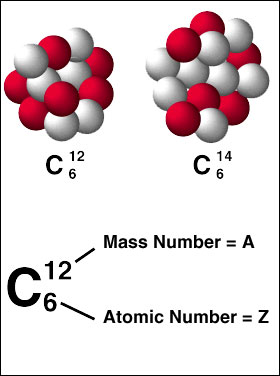
Mass number.
Mass number which is also known as the nucleon number, is the sum of the number of protons and neutrons.
Mass number which is also known as the nucleon number, is the sum of the number of protons and neutrons.
Mass Number = Number of Protons + Number of Neutrons.
Atomic number.
The number of protons in the nucleus of an atom determines an element's atomic number. In other words, each element has a unique number that identifies how many protons are in one atom of that element. For example, all hydrogen atoms, and only hydrogen atoms, contain one proton and have an atomic number of 1.
references taken from: wkipedia
Subscribe to:
Posts (Atom)