Proton
A proton is one of the most important types of subatomic particles. Protons combine with electrons and (usually) neutrons to make atoms. Protons are nearly the same size as neutrons and are much larger than electrons. A proton has a mass about 1,836 times greater than the mass of an electron, but the masses of protons and neutrons differ from each other by less than one percent. A proton has a mass of 1.6726 x 10⁻²⁴ grams.
Protons have a positive electrical charge, which is sometimes called the elementary charge or fundamental charge or a charge of +1.
Wednesday, July 28, 2010

Electron
Electron
Electrons are the negatively charged particles of atoms. Together, all of the electrons of an atom create a negative charge that balances the positive charge of the protons in the atomic nucleus. Electrons are extremely small compared to all of the other parts of the atom. The mass of an electron is almost 1,000 times smaller than the mass of a proton.
Electrons play a major role in many chemical bonds. There is one type of bonding called electrovalent bonding (ionic) where an ion from one atom is transferred to another atom. It is an even trade, creating two ions. The second type of bonding is called covalent bonding.
Electrons are the negatively charged particles of atoms. Together, all of the electrons of an atom create a negative charge that balances the positive charge of the protons in the atomic nucleus. Electrons are extremely small compared to all of the other parts of the atom. The mass of an electron is almost 1,000 times smaller than the mass of a proton.
Electrons play a major role in many chemical bonds. There is one type of bonding called electrovalent bonding (ionic) where an ion from one atom is transferred to another atom. It is an even trade, creating two ions. The second type of bonding is called covalent bonding.
Tuesday, July 27, 2010
Mass number and Atomic Number
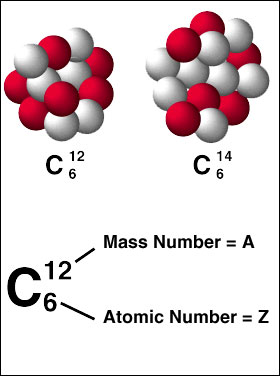
Mass number.
Mass number which is also known as the nucleon number, is the sum of the number of protons and neutrons.
Mass number which is also known as the nucleon number, is the sum of the number of protons and neutrons.
Mass Number = Number of Protons + Number of Neutrons.
Atomic number.
The number of protons in the nucleus of an atom determines an element's atomic number. In other words, each element has a unique number that identifies how many protons are in one atom of that element. For example, all hydrogen atoms, and only hydrogen atoms, contain one proton and have an atomic number of 1.
Atomic number.
The number of protons in the nucleus of an atom determines an element's atomic number. In other words, each element has a unique number that identifies how many protons are in one atom of that element. For example, all hydrogen atoms, and only hydrogen atoms, contain one proton and have an atomic number of 1.
references taken from: wkipedia
Atom

The atom is a basic unit of matter that consists of a dense, central nucleus surrounded by a cloud of negatively charged electrons. The atomic nucleus contains a mix of positively charged protons and electrically neutral neutrons. A group of atoms can remain bound to each other, forming a molecule. An atom containing an equal number of protons and electrons is electrically neutral, otherwise it has a positive or negative charge and is an ion. An atom is classified according to the number of protons and neutrons in its nucleus: the number of protons determines the chemical element, and the number of neutrons determines the isotope of the element.
atoms are composed of pieces like neutrons, electrons, and protons.
references taken from: wkipedia
Monday, April 26, 2010
Duodenum (Small intestine)

The duodenum is part of the small intestine. Some of the food that was digested in the stomach will then move on to the duodenum. Here, all classes of food is digested.
The enzymes present in the duodenum would be: pancreatic amylase, lipase, trypsin and maltase. All undigested food will then be transported into the large intestine.
reference: http://www.daviddarling.info/encyclopedia/S/small_intestine.html
Friday, April 23, 2010
Mouth
There two actions that take place in the mouth, physical and chemical.
First, the teeth chews the food into smaller pieces and the tongue rolls it into balls.
The enyzme in the mouth which is known as the salivery amylase then breaks down starch into maltose, this is where starch digestion takes place. The food then travels down the oesophagus.
First, the teeth chews the food into smaller pieces and the tongue rolls it into balls.
The enyzme in the mouth which is known as the salivery amylase then breaks down starch into maltose, this is where starch digestion takes place. The food then travels down the oesophagus.
Tuesday, April 20, 2010
Stomach
The stomach is a part of the alimentary canal. The stomach only secretes one enyzme, and thats proteas to help in the digestion of food it also secretes hydrochloric acid. As we all know enyzme helps to work on the protein, so what does hyrochloric acid do? It helps to kill the foreign bacteria, this is also one of the reasons why the stomach is so acidic, cause it contains hydrochloric acid.
sorry, i dont know why all the videos i upload all turns out like that, i'll try to solve the problem meanwhile, just double click on the video so that it directly leads you to youtube and you can watch it from there, sorry.
sorry, i dont know why all the videos i upload all turns out like that, i'll try to solve the problem meanwhile, just double click on the video so that it directly leads you to youtube and you can watch it from there, sorry.
Subscribe to:
Posts (Atom)